


Configure.
The end customer configures a product by combining product and service options, in a powerful product configurator that immediately displays a 3D render and a Bill Of Materials.
Streamline your growth.
CPQ stands for Configure, Price, and Quote. But it represents much more than an acronym. It is a powerful engine designed to take the friction out of selling complex, customizable products.
By uniting sales reps, engineers, distributors, and customers on a single platform, a CPQ solution ensures that everyone — from the initial inquiry to the final order — is working with the same accurate data.
It transforms the way you do business, turning technical hurdles into a streamlined, error-free path to purchase.
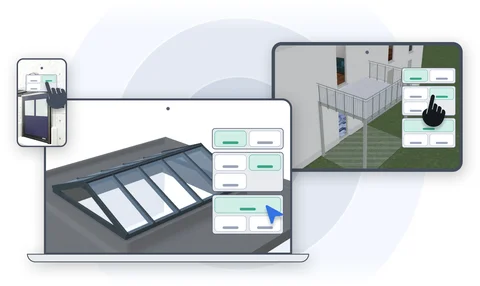
The end customer configures a product by combining product and service options, in a powerful product configurator that immediately displays a 3D render and a Bill Of Materials.

The CPQ software instantly calculates the correct price. To do this, the system gets its information from ERP, so you're always using the most recent prices. CPQ also takes into account factors such as discounts, shipping costs and more.

The user instantly generates a quotation of the requested products, in just one click. That way, not only does the customer receive a quote much faster, but the sales team also saves an enormous amount of time by no longer having to manually prepare quotes.
Our new CPQ-driven ordering system has become a strong sales argument for dealers, and we’ve seen their numbers increase since the launch.Frank ter Steege Commercial & Marketing Manager at Zolare

Accelerate your sales cycle and reclaim valuable time with CPQ software, letting your team focus on closing deals, not administrative burdens.

Hive CPQ’s rule-based product configurator eliminates costly mistakes in configurations and orders.

Experience effortless connectivity with our seamless integrations, ensuring your systems work together in perfect harmony.

CPQ eliminates the manual overhead behind every quote, cutting operational costs while giving your sales team the speed and accuracy to close more deals.

Game. Set. Match. Impress customers and drive engagement with a polished, tailor-made interface that perfectly reflects your brand.
A CPQ platform is more than just a tool. It is a strategic sales engine. To determine if your organization is ready for this transformation, you must first audit your current sales workflow.
The reason product configurators are so popular with manufacturing companies is because they simplify the product offering and help the customer make the right decision.
With complex products, customers or sales reps can lose sight of which product options are combinable. A CPQ configurator takes your ‘product rules’ into account and will never show a configuration that isn’t being sold.
Preparing quotations is a very time-intensive process. You can even miss out on deals because it takes days or even weeks to get a quote out the door. Thanks to CPQ, manually calculating prices is a thing of the past. In fact, a good CPQ software takes into account volume discounts, pricing by region, shipping costs and more.
Because CPQ software bundles all the information in one place, you’re always working with the latest options, pricing, inventory and more.
Changes in product offerings or price adjustments can be difficult to communicate to dealers. Chances are they are often working with outdated information. Using CPQ keeps your distributor network in the loop.
Choosing the right CPQ isn't just about software — it’s about finding a long-term partner for your digital evolution. Picking the wrong fit can lead to expensive delays and "shelfware" that nobody uses. To ensure your investment pays off, focus on these four critical pillars of a successful implementation.
Start with your “must-haves.” Are you looking for polished, professional PDF quotes, or do you need a deep-dive shipping module to track real-time delivery?
Consider the visual experience: is a simple 2D photo sufficient, or do your customers require an interactive 3D model with photo-realistic rendering? Map your unique business requirements against the software’s core capabilities to ensure a perfect functional match.

A powerful tool is useless if your team or your customers find it frustrating. If you plan to open your configurator to distributors or end-users, user-friendliness isn’t a luxury; it’s a requirement.
The interface should be so intuitive that a first-time user can configure a product and generate a quote without a manual. High adoption rates are only possible when the technology stays out of the way of the sale.

Implementation is a marathon, not a sprint. Building logic, syncing systems, and rendering assets can take months of focused effort. Look for a vendor that provides hands-on support during the setup and remains a reliable resource for troubleshooting, new employee training, and updates.
A partner who can take the maintenance load off your plate will save your team hundreds of hours in the long run.

Your CPQ should be a foundation, not a cage. As your business expands, your platform must handle new languages, fluctuating global currencies, and an ever-growing product catalog with ease.
Ensure the system can pull real-time pricing from your ERP and allow you to build new configurators without starting from scratch. The best CPQ is one that feels as fresh and capable five years from now as it does on day one.

Our CTO, Stijn De Mulder, took the stage at one of our CPQ Inspiration Sessions to break down the must-have capabilities for any modern manufacturing stack.

